|
When Pete Pottender gets home in the evening, he puts the fish in the freezer, crowding out the bags of ice-cubes and the TV dinners. His wife, who relies on the dinners because she is holding down three jobs to pay the mortgage held by NeptuneBank on their modest, two-bedroom cottage, is beginning to complain. But Pete insists the fish are too potentially valuable to throw away, and there is a huge market for frozen fish somehwere out there, in land-locked countries. Mrs. Pottender, who once got an "A" in geography at Farn Secondary Modern, points out that on the Vex there are, in fact, no land-locked countries and wonders where he even got the concept. Pete mumbles vaguely about the imminent advent of space travel. The Pottenders' freezer is crammed because the profits on flounder are flatter than the fish these days in the quaint coastal villages of Port Marie, more than 75% of whose population lives from the once-flourishing coastal and deep-sea fisheries. The catches are superabundant, and consumer demand for fish (fresh, not frozen) match the catches. But Port Marie's fisherfolk are not flourising because of a concommitant result of their recent reunion with Altland as its first and only Crown Colony. Neptune's Bounty, CCC, a so-called Crown Chartered Corporation headquartered in Nieumarktshavn, Estgorth, holds a royal patent issued at the end of the last century which grants it exclusive rights within the sovereign territories of Altland to buy and wholesale all the fish taken in Altlandic territorial waters. The only retail seafood which does not pass through its elaborate network of processing plants and distribution centers is that sold directly from small fish-mongers stalls by the fisherfolk themselves. The granting of this monopoly once made eminent good sense, since only the sparsely populated mountainous areas do not have direct access to the small direct sellers. |
Before the era of modern refrigeration (which in slow-changing Altland means until quite recently), this monopoly was the most efficient way to insure the even quality and the wholesomeness of the mass-distributed product. In Altland itself people are so used to living with this exclusive patent that it has never been effectively challenged by potential competitors. Now, however, it is causing a problem in Port Marie, which the Neptune's Bounty Corporation insists now falls under the terms of its patent.The locals in Port Marie object vigorously, especially outside of the colony's capital city, where Neptune's Bounty has for some time maintained a large wholesale purchase and distribution facility. When local wholesalers stubbornly persisted in buying up the catch, they found themselves served with injunctions issued by a magistrate of the Maritime Court in Grethavn, a person and institution of whom they had never before heard, but which now claim jurisdiction over their business affairs. They have fought back buy apparently going out of business, but they are accused by Neptune's bounty of conducting it almost as usual, although "under the table." But this may not be the case, considering the Pottenders' over-filled freezer. Neptune's Bounty is finding it hard to drum up support in their uneven wrestling match with the fisherfolk. By its own account the largest seafood business on the face of the Vex, Neptune's Bounty easily turns an enormous profit annually, mainly from export. It has over the past ten years expanded into dozens of other kinds of commercial enterprise, including the bank 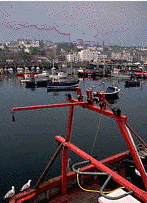
Idled: Northport's flounder fleet. |
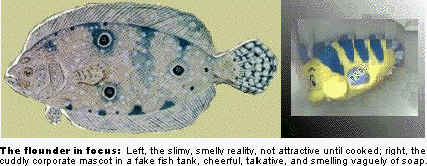
which holds the Pottenders' mortgage. In spite of its intensive public-relations effort, which features a cute and huggable rubber flounder named "Fred," the corporation has not quite succeeded in convinging the public that it is as benevolent as its carefully-crafted image would want to make the Vex believe. The fisherfolk of Part Marie insist, in fact, that would best be represented, not by a cutesy bath-tub toy, but by a very real and voracious shark. NB is willing to give them less than two-thirds of the price customarily paid per pound for fresh flounder by the small local wholesalers. And since it has put them out of business (at least to all appearances), the fishers have no alternative but to accept their drastically reudced income. Meanwhile, the coporation's gigantic NeptuneBank, which recently succeeded in a hostile take-over of its small-time Port Marie competitor, Maryport Mercantile, has instituted the first foreclosure proceedings against fisherfolk who have fallen behind by a month on their mortgage payments (Maryport Mercantile was in the habit of carrying them through lean days). Royal Governor the Marquess of Belvue barely had time to unpack his bags and get his uniforms pressed when he was constrained to return to Midlburgh for consultations on the matter with Chancellor for Overseas Territories Sir Alexander C. Alexicot. He has promised the Premier of Port Maries, Wilfred J. Bargaren, that he will do his best to have the Colony exempted from the authority of the Altlandic Maritime Courts, thus destroying the legal mechanism for the enforcement there of NB's royal patent. For his part, Mr. Bargaren, who has been experiencing increasing difficulties in maintaining party discipline over the issue, has begun talking of an appeal directly to the King himself. About this, however, there has been no word from the Arch-Chancellery. Because Altland has never before in its modern history had a crown colony, the current situation is unprecedented and apparently unanticipated by Alexicot, the architect of his nations's overseas expansion. Considering this, together with the size and resources of Neptune's Bounty, not to mention the legendary stubbornness of the Port Marie fisherfolk, it is impossible to predict how the problem will be resolved. |
|
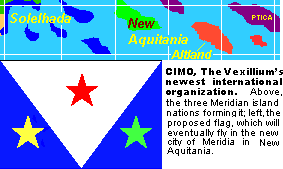
Their governments have radically different forms, their public personae could not be in greater contrast, their economies are not heavily involved with one another, but perhaps the unlikeliest grouping of nations in the history of the Vex appears to be all but concluded at high-level talks being conducted in the New Aquitanian capital of Cuitat. What Solelhada, New Aquitania, and Altland (also officially "Alterra") have in common, aside from geographical proximity, is language. Before its reunion with the United Provinces of Disonda, an autonomous principality which just this month returned once again accepted Altlandic monarch George II Victor as its Prince, the majority of the King's subjects spoke the Jermanic language they call Teutsprek, while only approximately 40% spoke a Romanic language referred to officially as "Romança." Now, however, with the Disondan population of 11.2 million added in, the kingdom is genuinely bilingual, with about equal numbers of His Altlandic Majesty's subjects speaking each language. With this impending change in the linguistic and cultural situation perhaps in mind, Acting Chancellor for Diplomatic Relations Genthar Jengling, on order from the Jergenpalas, took the unusual step, toward the end of May, of inviting the two other Meridic Ocean neighbors, which had been somewhat cool initially in their official attitude toward the restored monarchy, to estalblish formal diplomatic relations at the ambassadorial level. Both responded cautiously, especially Solelhada, which had long maintained a claim to certainly rather vaguely defined areas in southwestern provinces of Altland, once the independent Kingdom of Romania. But this difficulty was overcome when the Altlandic government proposed the giving of guarantees about cultural autonomy to the Romandian provinces and the opening of cultural and linguistic institutes at four of Altland's universities, with similar facilities to be supported at comparable Solelhadan and New Aquitanian institutions. New Aquitania then proposed a preliminary conference in its capital, where the three countries, in addition to normal bilateral relations, might also form a permanent regional organization, The Council of the Isles of the Meridic Ocean (CIMO for short). |
The other
two nations quickly climbed on board, and, at a signing ceremony
in Cuitat on 15 July, the organization was born. According to
the official statement posted on the organization's Web page,
put up by CIMO's still largely New Aquitanian Secretariat:
"The
Council of the Isles of the Meridic Ocean is an international
organisation based in the city of Meridia, New Aquitania. During
the construction of this city a provisional seat will be used
in Ciutat, New Aquitania. Its main role is to strengthen imagination
and the rule of law throughout its member states. The defence
and promotion of these fundamental values is no longer simply
an internal matter for governments but has become a shared and
collective responsibility of all the countries concerned. "The Council of the Isles of the Meridic Ocean is also active in enhancing the Meridic Ocean's cultural heritage in all its diversity. Finally, it acts as forum for examining a whole range of social problems, such as social exclusion, intolerance, the integration of migrants, the threat to private life posed by new technology, bioethical issues, terrorism and criminal activities ... It had established a significant body of standards and co-operation agreements. "The member states recognise how important it is for security and stability that all the countries should accept the above principles. Under that general concern for security, the Council of the Isles of the Meridic Ocean has laid down a series of common principles governing the protection of national minorities, and strengthened its machinery for monitoring its members' respect for their undertakings." Altland's role in CIMO is as yet only vaguely defined, but its first concern is clear: the cultivation of its newly important Romandian culture and language, which is what it most deeply shares with its partners. |